
Sharon Stone’s Carly Norris – a Manhattan book editor – moves from ‘the village’ into the Sliver building, a ruddy coloured high-rise, thrusting its tip into the sky like it was asked to solve a math problem at the blackboard. We primarily see the building from the ground up, its length and width either exciting or intimidating. The truth, however, is this: it’s not the size that matters, it’s what you do with it.
The Sliver building can be limp and uninspired in key aspects: cramped, badly designed kitchens; no in suite laundry; mirrored, sliding closet doors-a tacky way to otherwise enliven a boxy master bedroom. The building can also pound away incessantly at you with its gauche aesthetic. Every bathroom has fixtures and layouts ideal for staging pornography scenes. The male tenants are leering creeps and are sometimes murderous on top of it. The overhead lighting cuts out just when you need it most (I.e. running for your life from a homicidal maniac in a steep stairwell.) The owner is disinterested in repairs while also surveilling his tenants via surreptitious spy cameras installed in their apartments.

Girl, put some tape over your webcam!
A new Baldwin is manufactured for every role the Alec model shows interest in but eventually turns down and Sliver‘s prototype is named William, who plays the building’s voyeuristic owner, Zeke. Zeke’s apartment suggests a certain arrested development with its student dormitory disarray, but a secret central command for his spy operation hiding within his apartment tells us otherwise. There is a control and attention to detail and a design sensibility (like if Batman commanded the bridge of the Enterprise) that betray the maturity and patience it takes to see through a project of such scope. His spy rec room is a sanctuary for his secrets. The residents of his building are not granted the same privilege of a private space in their units. Zeke oversees all as a passive watcher, content to label what he sees as ‘soap operas,’ scooping up knowledge about the private lives of his tenants, but only acting on what he see when it furthers his interests (sex, murder, preferred flower arrangements of potential dates).
Carly’s work as an editor of books personifies in her a belief in narrative, particularly in the activity of articulating and bolstering aspects of story that demand action. She is somewhat turned on by Zeke’s voyeurism, but is eventually sickened by Zeke’s insistence that they only watch. Carly eventually gains the pallor and disheveledness of an individual who has spent extended time in isolation with pornographic cinema. She has watched plenty of sex between consenting adults, but she has also witnessed secret addictions, domestic violence and a mother’s rejection of her daughter’s assertion that she has been sexually assaulted by her step-father. Her shame for her transgression of spying overwhelms her conviction that she should act on what she has seen.
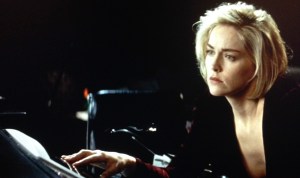
Can’t stop nosing in other people’s business
In a March 2018 interview, Sharon Stone reminisces with invigorating frankness about the state of mind and motives propelling Sliver’s production:
“Well, frankly, most people making that film were nuts. They were trying to repackage me after Basic Instinct and I think they were just attempting to take that movie’s energy and squeeze another hit out of it. I think they kind of did it but they could have done a better job.”
Carly is scripted as a woman consistently surprised at the doings of others. Stone, however, radiates a vivid intelligence that shreds this enforced naiveté and layers nuances into material meant to be consumed superficially. Instead of being a separate entity we relate to via her motivation and choices, Carly, due to her embodiment by Stone, becomes an audience surrogate, lamenting the destructive ego of the surveillance state.
Joe Eszterhas, the writer of Sliver, Basic Instinct and other canonical works of A-list smut, liberally tinted his work with feminist flourishes. An Eszterhausian woman is equipped to rail against the paper bag authority figures who arbitrarily stand in her way. Clothing is optional. In Showgirls, a woman is prompted to violently fight the systems of oppression around her. In Basic Instinct, a man is drawn to a submissive relationship with a queer woman who is deploying her homicidal tendencies toward clearing out patriarchal excess. In Sliver, a woman destroys her means of seeing with a penetrative and intrusive gaze after being seduced then sickened by its soullessness.

Justice Judy
Earlier in the film, Carly’s assistant Judy (Colleen Camp) cheers on Carly’s move to the Sliver as an opportunity for “new adventures, new horizons, new lovers, new orgasms!” Carly has desires that are dangerous or benign depending on how they are acted out while Zeke’s gets off observing individuals crush themselves under the weight of their secrets. Rebecca Solnit, in A Field Guide to Getting Lost, relates a story of classical lore where Justice “stood at the gates of Hades deciding who would go in[. To] go in was to be chosen for refinement through suffering, adventure, transformation, a punishing route to the reward that is the transformed self.” Perhaps Judy, with her enthusiasm for “new adventures, etc.,” is Justice for Carly, gently guiding her towards the hell of dating Zeke so that a transformed version of herself might emerge. After Carly fires a bullet between the eyes of Zeke’s pervy control room she says flatly, “Get a life.” It’s an admonishment as much to herself as it is to him.
Sliver was released in 1993 and was directed by Phillip Noyce.
Originally published on January 17, 2019.
Updated January 22, 2019 to include new post category and tags.
WORKS CITED
Solnit, Rebecca. A Field Guide to Getting Lost. New York: Viking, 2005
Thompson, Simon. “Sharon Stone on Her First $100 Paycheck And Her Fight To Direct.” Forbes.com. March 7, 2018. https://www.forbes.com/sites/simonthompson/2018/03/07/sharon-stone-on-her-first-100-paycheck-and-her-fight-to-direct/
 Yes Really Titley