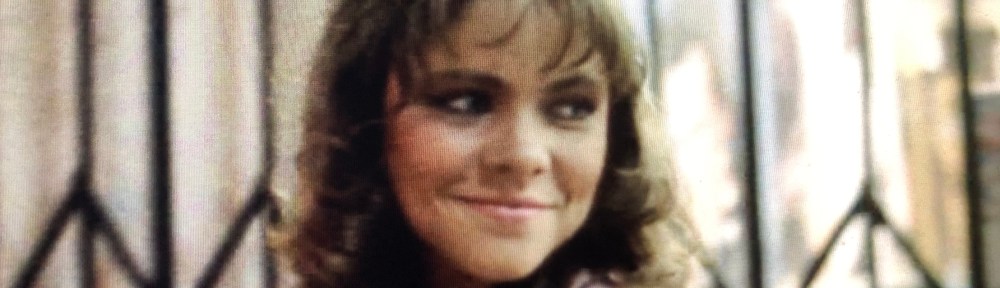
On the horror and exploitation cinema celebration website Kindertrauma, unkle lancifer reminisces about heading out to the pictures with a group of friends to see Angel on opening night in 1984:
“I’m sure teenagers still pack into cars on Friday nights and hit their neighbourhood movie houses but certainly gone are the days in which they can witness, on the big screen, a fresh slice of exploitation concerning a peer who is a high school honor student by day and a Hollywood hooker by night.”

In the 1984 film—the first in a trilogy—Angel is the nom-du-rue of Molly (Donna Wilkes), a teenaged woman abandoned by both parents and working as a prostitute on Hollywood Boulevard in Los Angeles to keep up with the rent on her family’s apartment and with the fees at the private school she attends. In the 1985 sequel, Avenging Angel, Molly is no longer hooking and now studying law in college. She has not abandoned the community of the streets and dons her old cloak of Angel to fight shady real estate developers who are willing to kill to rid the Boulevard of the trade. By the third and final film in 1988 (not including the unofficial fourth one in 1994), Angel III: The Final Chapter, Molly is working as an investigative photojournalist and again goes undercover as Angel to break up a human trafficking ring that has ensnared her resurfaced mother and step-sister.
Angel is honest about the misogynistic culture in which Molly faces obstacles and makes her decisions. Molly is a scholastically gifted young woman receiving a private school education. There is nothing that should stand in her way as she puts her gifts to work and ascend to success and security as a college-educated woman. Unfortunately, Molly attends class with the future Brett Kavanaughs of the world and they will not abide a woman who meets their entitlement with open contempt. “I have better things to do,” Molly tells Ric (David Underwood), a blond jock, when he leeringly asks her to help him ‘study.’ The better things she has to do are to take her chances as a teen hooker on Hollywood Boulevard! With a serial killer on the loose!
Later, Molly is picked up on the Boulevard by Ric and his toadies. To fend off their threat of gang rape, Angel pulls a pistol on Ric who subsequently pisses his pants and scampers away lest he get shot. He is not humbled, however, and blabs to the administration that Molly is a hooker with the expectation that she be expelled from school (as if her after-school job is any of their business). While Ric expects consequences for Molly for rejecting him twice, Molly has no such delusions after enduring Ric’s sexual harassment and rape attempt. Molly’s point of view is shaped by a resignation to circumstances, inspiring in her a perverse self-sufficiency wherein working as a baby-doll prostitute is her only way of meeting her economic needs (does her fancy school not have scholarships? Does the diner where she and her street-walking friends hang out not need a busgirl?).
Along with the Yale dorm party Molly is forced to attend high school with, the other threat to her personal autonomy is The Killer (played by John Diehl) stalking the sex workers of the Boulevard. The Killer’s violence brings the attention of the police, which unfortunately exposes Molly’s after-school life to the scrutiny of paternal looky-loo, Lt. Andrews (Cliff Gorman) of the LAPD. After we have been introduced to Molly’s friends on the streets, had a good look at her spic-and-span apartment, and learned that she is on the honor roll of her high school, the lieutenant offers his ‘concern’ for her by declaring her world “a toilet bowl.” Officer, if you want to help, start writing cheques to Molly’s private school, her landlord, and Fredericks of Hollywood (who probably, let’s be honest, sell Molly both her nighttime workwear and her daytime schoolgirl bobby socks.)
unkle lancifer argues that Angel is “an unheralded touchstone of queer cinema… What a valuable lesson to outsider youth, that there’s a world outside the window of the creepy, dollhouse room of emotional neglect they’ve been dumped in.” Yes, Molly is risking her wellbeing out there on Hollywood Boulevard, but with her are the sweet, simple busker Yoyo Charlie (Steven M. Porter), silver-screen gunslinger turned street raconteur Kit Carson (Rory Calhoun) and the elegant, grandmotherly Mae (Dick Shawn). Completing Molly’s quartet of caregivers is Solly, the folk artist and landlord-with-a-heart-of-gold who flourishes in trading foul invective with Mae. Solly is played by Susan Tyrell, who, on the set of 1990’s Cry Baby (as John Waters reports in his book Mr. Know-It-All) “would say to cast and crew she was introduced to, “Hi. I have the pussy of a ten-year-old.”” Perhaps Mr. Waters had not seen Angel and didn’t see this coming.
If all you’ve known is the narrow spectrum of spiritual, emotional, gender and sexual expression, the twists of square-supremacist icons are probably like a long painted-shut-window being pried open. Prim high school student? She’s a sex worker! Her teenaged friends? Fellow street walkers and performers! Her parents? Mae, an elder trans-woman, and Solly, a butch borderline personality. “[T]he upgrade of upgrades,” as unkle lancifer reveres them.
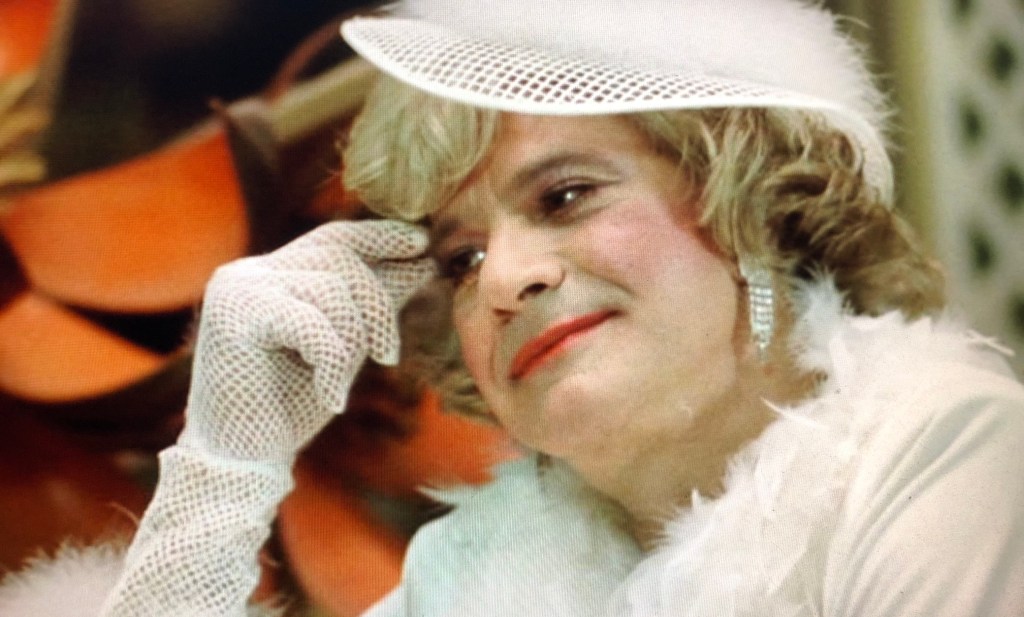

The greatest upgrade of all is the one performed on the American Cowboy. Strong and silent no more, Kit Carson (Rory Calhoun) is a gregarious ally to Molly and her friends. Kit spends his time telling stories of his past glory days on the sets of Hollywood Westerns and shooting blanks [from his pistol] up and down the Boulevard. The genuine pleasure and non-judgement he takes in conversing with everyone on the street is heartwarming. Unlike the lieutenant, his assistance is not limited to nebulous ‘concern’ for Molly and her friends. Kit spends some accumulated privilege as a white, male, ageing cowpoke, and eventually switches out those blanks for real bullets, landing a shot on The Killer when Molly and the lieutenant are incapacitated.
The notable examples above notwithstanding, just how successful is Angel in portraying an authentic slice of queer life? lancifer defines their notion of Angel within queer cinema as “not because of any overt sexuality, but because of the way it honors diversity and celebrates and defends deviation from the mainstream.” Ok, but what of the folks in the films that exist within the broad spectrum of sexual and gender expression and practice—you know, the folks who might identify as queer? Their pre-occupation is with the well-being of Molly, the white, intellectually privileged young woman. They do not centre themselves in a struggle for their own lives.
By and large, the diversity portrayed in Angel are the interactions between various economic fringe groups and working classes out on the Boulevard. The diner owner refills the coffee cups of the street walkers while chasing the homeless out – “the working girls pay the check,” he shrugs. Molly gives her extra bucks to a panhandler. A sex worker, Crystal, compares her business to that of ‘Yoyo’ Charlie, a street performer: “Up and down. Get it?” We get it, Crystal. We get it.
Molly consorts with a variety of hustlers in her prostitution work. However, for a film series set amongst sex workers starting in 1984, the omission of any talk or portrayal of AIDS is shocking. No mention of condoms or testing, no mention of friends and acquaintances getting sick, no euphemisms for the illness. In 1991’s Whore, Liz dismisses a client as stupid for requesting bareback service. And in 1990’s Pretty Woman, Vivian’s perky assurances about her frequent testing and her offer of a rainbow of colourful condoms to choose from make her reality more recognisable than Molly’s.
Sarah Schulman, in her book Gentrification of the Mind: Witness for a Lost Imagination, writes that AIDS “has not been integrated into the American identity of which it is a product. AIDS most often appears as a banal subplot in some yuppie’s inconsequential novel, or a morose distortion in a stupid movie.” The filmmakers of Angel couldn’t even muster that. Schulman argues that AIDS activists—primarily LGBTQ individuals—forced AIDS and its impact into the bubble of mainstream American consciousness via protest actions that appeared on the nightly news and prolonged battles to influence political policy. The intellectual capital, the creativity, the emotional depth, the scientific exactitude, the bodily risk of the activism, as well as the art of the AIDS era in response to the devastating human loss is too overwhelming to ignore. To file a 1980s film in ‘queer cinema’ that does not even hint at AIDS is woefully inaccurate.
So, if we cannot label Angel as queer, what can we call it? What encapsulates the neon details, the sensational melodrama and broad characters found here? If only there were a word for describing a sensibility that emphasises heightened theatricality over subtle development!
Angel has a tone that is too serious and too thin on grounded details to take seriously. In Notes on ‘Camp’, Susan Sontag writes, “What Camp taste responds to is ‘instant character’ (this is, of course, very 18th century); and, conversely, what it is not stirred by is the sense of development of character. Character is understood as a state of continual incandescence – a person being one, very intense thing.” Angel is nothing if not a cast of ‘instant characters.’
This begs the question if, to use unkle lancifer’s phrase, a “slice of exploitation” can, in fact be camp. Angel gains its exploitation credibility with the lurid premise of a teen girl working as a hooker. The film does not use the tools of, say, neo-realism to lay out the myriad of reasons a young woman might turn to hooking to survive. The realism in Angel extends to the real-life locations and local colour of after-dark Hollywood. Sontag says, “All Camp objects, and persons, contain a large element of artifice. Nothing in nature can be campy… Rural Camp is still man-made, and most campy objects are urban.” Angel’s artifice extends to characterisation, baroque plotting, and the unnatural collision of Hollywood glitz with working girl grit on the Walk of Fame.
“Camp is a vision of the world in terms of style – but a particular kind of style. It is the love of the exaggerated, the ‘off,’ of things-being-what-they-are-not,” writes Sontag. This captures unkle lancifer’s obvious joy for the film and better underpins their thesis about its appeal: that Angel is a sigil of hope for those experiencing deprivations of love, appreciation, community and/or culture, that is folks experiencing “ things-being-what-they-are-not” without the benefits of any “particular kind of style.”
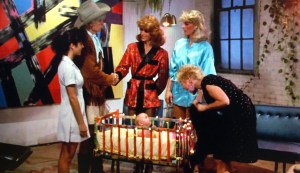
In 1985’s Avenging Angel, Molly (now played by Betsy Russell) is off the street and is bound for law school with the help Lt. Andrews (now Robert F. Lyons) from the first film. Molly has not shared the details of her past with anyone from her college life. “Why should you,” Andrews tells her. “Angel’s dead and gone. You have a whole new life now.” Unfortunately, he speaks too soon and is shot dead in a botched vice-squad action in Hollywood. Molly goes back to the Boulevard to avenge his death and swiftly dons her Angel garb to aid in her efforts. “I can find out a lot more on the street dressed as Angel than as Molly,” she reasons.
Sarah Schulman observes in Gentrification of the Mind a “spiritual gentrification…” that “alienated people from the concrete process of social and artistic change.” In one instance, this manifests in disconnection from the history of lived experience. In a talk to an AIDS-related organization, “[t]he HIV-positive women in the audience were mostly Black and Latina,” Schulman writes, and were self-described activists while working as students, community workers, safe sex educators and peer counsellors within “social service agencies, or as part of AIDS bureaucracies.”
Schulman shows this audience a clip from a film by Jim Hubbard about:
“ACT UP’s four-year campaign to change the Centre for Disease Control’s definition of AIDS so that women could get benefits. The film showed the early leaders of the women with AIDS movement, Black and Latina women—just like those in the audience…. When the lights came up, there was a kind of stunned silence. Later, I heard from many women in the audience, that they had no idea that any of this had ever happened….[T]hey did not know their own legacy of leadership. They did not know they could change the world, and that people in exactly their circumstances had already done so.”
Andrews’ words to Molly are meant to reassure her that the struggles and indignities she faced as Angel are “dead and gone,” but it is sadly ill-conceived to partition Molly from her previous experiences. Molly’s instinct to embody Angel again is more a culmination of the woman Molly has become—experienced and prepared—not the girl she once was. A knowing and weary community took care of Molly in the first film, now she can take care of others.
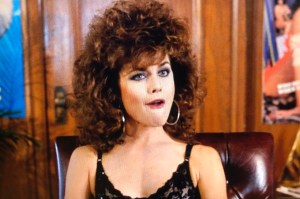
In 1988’s Angel III: The Final Chapter, Molly (this time played Mitzi Kapture) is still looking back into her past to influence her present. She is now a photojournalist and we can only speculate why she took up this trade instead of law. Perhaps it is because, through her camera, she witnesses familiar cycles of rejection and desperation, but also community care and resilience. She insists these images are important and worth being seen, though her editor (Dick Miller) tells her, “You’re wasting time. Who’s gonna want a book about crack-heads? Nobody gives a shit about street kids.” When Molly gets a lead on her estranged mother in Los Angeles, she races there from New York City to follow up.
Angel III is the sleaziest of all the Angel movies and that is truly saying something considering this a series about a teen hooker. Molly’s mother and Molly’s previously unheard of step-sister are ensnared in the dangerous web of Nadine (Maud Adams), the “biggest agent in town for all the X-rated girls.” Nadine’s talent agency is actually a front for a high-priced escort business featuring the very porn performers she represents. And that business is actually the tip of the iceberg in an international drug and human trafficking ring, with Nadine’s women being shipped off to “Calcutta whorehouse[s]” in exchange for bundles of cocaine!
To untangle this, Molly must first infiltrate the porn industry that provides the pipeline of women to Nadine’s businesses. She is assisted by Spanky (Mark Blankfield), an ex-hustler and current ice cream sales truck operator Molly knows from the boulevard, and Lt. Doniger (Richard Roundtree), the LAPD detective investigating the disappearance of Molly’s mother. Sontagian ‘instant characters’ in this film are Pam (Susan Moore) and Shirley (Barbara Treutlaar), two porn performers and escorts who are shoving the cash they make in sex work into real estate investments. “Let’s just hope the interest rates don’t bottom out before my ass does,” Pam chirps. As if almost to punish us for our admiration for their hustle and forward thinking, both women are fatally chewed up by Nadine’s machine.
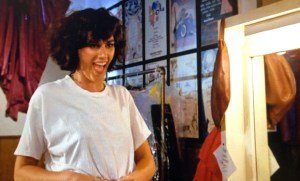
Social media has noticed—and has pushed back on— ‘perseverance porn,’ a news-media trend of supposedly feel-good stories crafted out of individuals facing alarming structural obstacles in the way of their quality of life. “Perseverance porn goes hand in hand with the rise of a GoFundMe economy that relies on personal narrative over collective policy, emotional appeals over baseline human rights,” writes Adam Johnson in the FAIR.org story, “Media’s Grim Addiction to Perseverance Porn,” citing viral stories of workers walking 10+ miles (and more!) to their jobs each day for want of public transit or humane city planning and of teachers donating their own sick days to a colleague battling cancer for want of short-term sick or disability leave.
Molly’s story could very well feature in one of these perversely perky yarns:
High Schooler Walks Streets to Pay for Basic Needs
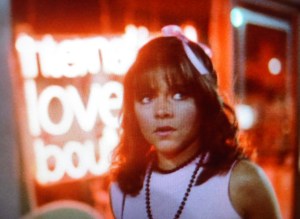
“I had to get out there and make a living,” 16-year-old Molly Steward tells KHWB Evening News. And *out there* she is, putting those smarts to work as the straight-A-student fantasy of her clients up and down Hollywood Boulevard…
The filmmakers of the Angel trilogy opted not to tell the stories of policy failures like broken foster and welfare systems, how schools fail students with stressors, or how criminalizing sex work harms all sex workers. They do show the emotional landscape of surviving these conditions.The first and second films’ preoccupation with Molly’s intellectual gifts serve to inflate her above and beyond the community she purports to help. She’s not like these people—she’s bound for college! Only she can help because she’s studying law! The community is in crisis, Molly is not.
But, then again, to demand that Molly lay out her trauma and hurt from what we, the viewer, have deemed ‘failures’ is to project our judgements and assumptions on her about how she has lived her life. Angel is her ‘instant character’ and it’s a pretty admirable one considering her selflessness. To force a current or past sex worker to perform their lingering pain because we feel it must be there is a form of exploitation, and it’s something Molly would never stand for.
The films of the Angel trilogy were…
Angel, released in 1984 and directed by Robert Vincent O’Neil
Avenging Angel, released in 1985 and directed by Robert Vincent O’Neil
Angel III: The Final Chapter, released in 1988 and directed by Tom DeSimone
WORKS CITED
Johnson, Adam. “Media’s Grim Addiction to Perseverance Porn.” FAIR.org. August 3, 2017. https://fair.org/home/medias-grim-addiction-to-perseverance-porn/
lancifer, unkle. “Angel (1984.)” kindertrauma.com. May 8, 2015. https://www.kindertrauma.com/angel-1984/
Pretty Woman. Dir. Garry Marshall. 1990
Schulman, Sarah. The Gentrification of the Mind: Witness to a Lost Imagination. University of California Press e-book, 2012.
Sontag, Susan. Notes on ‘Camp.’ Penguin Modern, 2018. Originally published in Against Interpretation and Other Essays (1966.)
Waters, John. Mr. Know-It-All: The Tarnished Wisdom of a Filth Elder. New York: Farrar, Straus and Giroux, 2019.
Whore. Dr. Ken Russell. 1991.
 Yes Really Titley