
The Scarlet Letter

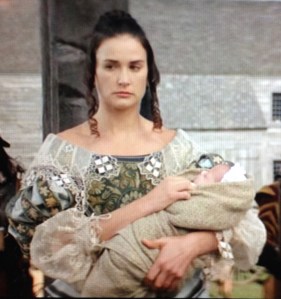
Demi Moore as Hester Prynne arrives on the shores of Puritan New England with lace embellishments on her outfit and crazy notions of acquiring her own home to live in solo, while her husband is otherwise occupied with parking the schooner or testing the patience of the neighbouring Algonquin population. She says and she does with open-hearted personal authority and does not wait for permission to go about her business. Naturally, the colonists hate her.  In The Scarlet Letter—richly transcending the source novel—‘A’ is for authority, agency and authenticity.

Gary Oldman, as Rev Arthur Dimmesdale, has a face only a sexually pent-up pilgrim would want to sit on. They meet when Dimmesdale helps her out after her carriage blows a tire. He seems not perturbed that she is alone and eager to make her acquaintance. What follows is a series of meet cutes as the two develop an attraction to each other. Eventually, Hester receives word (via Dimmesdale, the sly fox) that her husband has perished (no body though!) and, after deciding that the seven years of grief dictated by puritan law is arbitrary and stupid, they go to the barn for some privacy and have sex on a pile of grain.
IMG_4872

If someone put the above on a t-shirt, I’d wear it!

Hester’s sweet, Instagram-ready decor scheme and scandalising fashion choices are rivalled (in a friendly way) by the bold accessorising and whimsical yard design of a farm for rebel ladies run by Harriet Hibbons (Joan Plowright.) “When first we came,” she reminisces, “there was dancing around the maypole. […] Now a whipping post stands where the maypole used to be.” The fashion and decor practiced by Hester, Harriet, and others is an expression of the freedom the puritan culture hasn’t wrung out of them. And this tight grip of control is only getting worse at the time of Hester’s arrival. 

“You don’t put her in prison. You put the prison in her,” advises Meredith Stonehall (Dana Ivey), the wife of a Puritan dingdong overseeing Hester’s fate after she falls pregnant with Dimmesdale’s child. This is a chilling piece of fashion policing theory. Hester’s style—loose and lacy—has rankled from her arrival, and the scarlet ‘A’ for adulteress she is forced to wear is a perverse adornment for a woman who would otherwise only wear a colourful accessory when feeling agency to do so.

IMG_4868

In The Addams Family, Dana Ivey’s character rejects the thieving, duplicitous, cis-supremest scheming of Dan Hedaya for Cousin It. Her character’s intellectual backflips for repressive Puritanism here are a knife to the heart.

After the birth of Pearl—Hester and Dimmesdale’s daughter—we discover that Hester’s husband, Roger (Robert Duvall), has been alive all along, living in captivity with a tribe of Indigenous people.We are shown quickly why Hester mourned so little for Roger after his ‘death’ when he aggressively forces a wash cloth into her face and flips a bowl of water at her upon his arrival in her home. He then ensconces himself with the colony’s head gargoyles (concealing the fact that he is Hester’s husband), facilitates the gang assault of Hester’s female slave (to coerce her into spying for him—he later murders her), declares Pearl to be “the Devil’s own child!” (he would know), and murders a man leaving Hester’s home thinking he is Dimmesdale. (Nope! This man dropped in with the sole intent to rape Hester.) The murder is done in a way that implicates the Indigenous peoples, starting a war. This fuckin’ guy.

The film seemed like an opportunity to collectively express frustrations with Demi Moore’s naked ambitions for herself. A February 1994 news article from Entertainment Weekly opens with “Demi Moore as a Puritan? Stop that snickering. The actress who twice took it all off for the cover of Vanity Fair is about to sign on to play the role of Hester Prynne…” You know what? Hester requires grit, determination, confidence in speaking one’s mind, and the sexiness that emerges when an individual possesses those qualities. A 1995 Rolling Stone Q&A includes the following quote from Michael Douglas, the holy ghost of the divine trinity of erotic thrillers, Basic Instinct, Fatal Attraction and Disclosure: “Demi gets more done in a day than most guys do in a week. She’s really running on all cylinders.” Hester is more Demi than not.
IMG_4866

The most important fashion catwalk is the perp walk. – John Waters                                        (See also: Lori Loughlin; Leona Helmsley)

A viral tweet from @LLW90210 in 2018 punctuated a simmering discussion online about men and their terrible living quarters:

“every straight girl on this site has an apartment filled with stunning art, plants and vintage furniture but is in love with a man who sleeps on a bare mattress next to his PS4”

Both vox.com and vice.com published reporting in late 2018/early 2019 on the internet perception of men eschewing bed frames (Vice) or forgoing decor, save for, yes, a video game console and an easy chair, altogether (Vox). Both pieces take pains to acknowledge that lousy apartments, lack of interest in decor, and a general tolerance for disgusting housekeeping practices are not gendered male exclusively, nor are decor, style and tidying exclusively female interests. However, the internet’s teasing was getting at something that felt true, even if not verified by social scientists nor biologists. “Look, I don’t have the demography,” one man who is without a bed frame is quoted in the Vice piece, “But I think that society encourages women to take care of themselves in a way it doesn’t really for men.”  

This meme gets at a very real anxiety. If an old pizza slice in the bathroom, disused gym shorts as pillow cases, and a variety of handguns lying about the living room floor (all examples from the Vox piece) are acceptable, where does that leave art, greenery and vintage furniture, let alone the person who chose them with care?  Hester made the most of the home she chose (yeah, she was hoping the husband would never show up), but, just like her fashion, found that it still meant nothing when it came to asserting her autonomy where the colonists were concerned.

Hester has a slave, Mbtuba (played by Lisa Andoh), but the film does not develop the inherent conflict in Hester demonstrating personal agency while denying another woman hers. As mentioned previously, Mbtuba pays with her life for Hester’s crimes, absorbing the colonists’ worst impulses for punishment and debasement. If Hester is assigned the scarlet ‘A’ to wear as a walking prison, Mbtuba has worn her prison for far longer as an enslaved black woman, compounded by Hester being her mistress. We are all implicated in her imprisonment. 

The Scarlet Letter was directed by Roland Jofeé and released in 1995.

WORKS CITED

Brennan, Judy and Cagle, Jess. “Casting ‘The Scarlet Letter.'” EW.com. February 4, 1994. https://ew.com/article/1994/02/04/casting-scarlet-letter/

Jennings, Rebecca. “Why the internet loves dunking on guys’ terrible apartments.” Vox.com. December 19, 2018. https://www.vox.com/the-goods/2018/12/19/18141261/apartments-bad-male-minimalism-twitter-meme

@LLW90210 (Lauren). “every straight girl on this site has an apartment filled with stunning art, plants and vintage furniture but is in love with a man who sleeps on a bare mattress next to his PS4” twitter.com. August 5, 2018. Account suspended. (Accessed via Jennings, Rebecca. “Why the internet loves…” on June 5, 2019.)

Udovitch, Mim. “Q&A: Demi Moore.” February 9, 1995. rollingstone.com. https://www.rollingstone.com/movies/movie-features/qa-demi-moore-202654/

Yagoda, Maria. “Why Do So Many Adult Men Keep Their Mattresses On The Floor.” vice.com. February 5, 2019. https://www.vice.com/en_us/article/vbwvqx/why-do-men-keep-their-mattresses-on-the-floor


The Last Seduction

In what suburban basement has The Last Seduction been hiding in since its release in 1994? Beyond an enthusiastic endorsement from Samantha (Kim Catrall) and Miranda (Cynthia Nixon) in the 1998 pilot episode of Sex and the City, we have not heard much about Seduction or Bridget, the film’s diabolical lead, or any legacy left behind in the twenty-five years it has been around. Perhaps there is a reason for that.

Roger Ebert, in his review of the film upon its release, deliciously described the set-up of the film:

“As the movie opens, she [Bridget, played by Linda Fiorentino] and her husband [played by Bill Pullman] have made a big haul – $700,000 in illegal funds. Then he makes the big mistake of hitting her in the face. He knows it’s a mistake: ‘Hey, you can hit me anywhere, hard.’ During the course of the movie she will accept his invitation, in her own way.”

The quotation from Ebert’s review is cut off before it can get into the sausage fixings of where this film truly goes. Bridget is beyond seeking revenge or justice from her husband for hitting her and this violence is far from the turning point Bridget needs to empower herself to leave a toxic marriage. We suspect that Bridget has seen through her cheap suit of a husband for a long time and her pre-requisite to leave was $700,000 cash.

On the advice of her flypaper lawyer who is drawing up and serving her husband papers for divorce, Bridget sits tight in the upstate community of Beston. Bridget is hoarding the cash until her divorce comes through, cornering her husband into not being able to make a claim unless he wants to explain to the authorities how they came into the money. (“Are you still a self-serving bitch?,” her lawyer asks, just making sure she does not have a case best suited for the ACLU.) While in Beston, Bridget finds a job (in phone sales–yes, she is an aggressive telemarketer,) and a sexual plaything (Peter Berg, who wears a perpetual ‘huh?’ expression), all the while collecting the pieces she will later fit together into her triumph.

In collecting those pieces, Bridget embraces a specific freedom that is predicated on others buying into destructive narratives about themselves and the world around them. When Harlan (Bill Nunn), a private detective sent by her husband, corners Bridget in her car with the sole aim of retrieving the cash, Bridget taunts him about the size of his penis, wondering whether or not it would live up to her expectations of that of a black man. To shut her up, he whips it out. Bridget then crashes the car and sheepishly says to the investigating (white) police officer, “The jist of [his threat] was, he was going to, um, impale me with his…big….” The police officer finishes the story without asking for further detail.

Bridget’s Beston plaything, Mike, employs willful blindness in his relationships with the women in his life. Bridget is unambiguous about her expectations for their relationship when they first meet: just sex. He, rather than ending a relationship that does not give him what he wants or embracing the form it is taking, continues to pester Bridget for more. When she does invite him into her home and heart (what’s left of it), the condition is that he help her sell the murders of cheating husbands to betrayed wives over the phone. Bridget correctly guesses that Mike has an ex-wife and that their marriage was impulsive. “[O]ne of those sudden, horny things,” she says. Mike confirms this but does not say more beyond the following: “Trish was a mistake. Boy from Beston moves to Buffalo, gets lonely, meets girl, screws up big time.”

Intuiting that there is a secret to exploit, Bridget, without Mike knowing, goes looking for Trish (played by Serena) in Buffalo and discovers that she is a trans woman. A cis-man making love with a trans-woman is an expression of a broad spectrum of desire for both parties. Bridget contorts this narrative into one that says Mike sought out and liked sex with a man and is gay and is a joke for trying to pretend otherwise. Her final ploy to put him in his place is to verbally humiliate him about his denied queerness while simultaneously inciting him into a rape role-play that requires him to act out his violent trans-misogyny on Bridget. Bridget dials 9-1-1 so that the operator might hear her screams and pleas for help during the act. (Her reminder to Mike, “I’m Trish,” is whispered out of range from the phone receiver.) Mike is arrested as a result.

Both the character of Harlan and the character of Mike have choices, once of which is to listen to the audience screaming out ‘Don’t fall for it!’ They listen to Bridget, however. While plotting her next moves, Bridget has choices as well about when and how she will use circumstances as they present themselves. Oftentimes, these are circumstances she did not create.

Mike left his wife in Buffalo prior to Bridget arriving in town. For a man who lays his cards on the table with Bridget (he claims he is “hung like a horse” and is vulnerable in voicing his want for a life bigger than Beston can provide), his reluctance to give details about his marriage is inconsistent. Bridget intuits that he will do anything for her if it means avoiding being honest with himself about Trish and their recent history.

Bridget is tipped to how the town takes to Harlan’s presence when her office’s receptionist emphasizes repeatedly that he is a black man. (“Did you tell her about the black guy?,” a co-worker asks the receptionist on the button of the scene.) She then puts to work racist ideas that say black men’s bodies are unnatural and available for her to gawk at, and that black men’s sexuality is predatory when it comes to white women.

Linda Fiorentino’s body as Bridget is in motion—smoking, drinking, hand-writing, posing, sprinting, strutting, grinding, dressing, undressing, luxuriating or vibrating in thought—for the entirety of the film. Yes, sex and seduction are in her toolbox, but Bridget’s long game is played primarily by learning and exploiting the weaknesses of her opponents. This work is done with the voice; asking the right questions; knowing the right details; adopting the right tone; saying the right thing at the exact right moment.

It was said in the entry on Sleeping With The Enemy that “[w]omen fleeing violence often trade their voice for their security.” All the previous films in this series can be read as meditations on voice and, by extension, agency. Whore is the most prominent of this theme, with the female lead, Liz (Theresa Russell), speaking directly to the audience, in control of at least the narrative of her life, where the day-to-day realities are of a profession that can spiral into personal chaos at any second. Bridget deploys her voice to create chaos for others, to fuel her own personal agency.

And what is the root of the chaos Bridget creates? Bridget’s voice is effective when the narrative she spins centers white supremacy, patriarchy, and cis-supremacy as the secondary beneficiary, after herself of course. Her voice is listened to when she dehumanizes black men. She is listened to when she portrays herself as an innocent victim of the violence of others. She is listened to when she confirms for an insecure man that queerness is less-than and that only domination is acceptable. To know what to say at the exact right moment is to know exactly the context in which what you say will be received. Bridget embraces contexts that perpetuate systems of oppression. Her voice is violence. Let’s not give her any further credit for it.

The Last Seduction was directed by John Dahl.

Originally published on February 19, 2019. 

Updated on February 26, 2019, to include the name of the film’s director.

WORKS CITED

Ebert, Roger. “The Last Seduction.” Rogerebert.com. November 18, 1994 (originally published in the Chicago Sun-Times.) https://www.rogerebert.com/reviews/the-last-seduction-1994

Sex and the City.” S01, E01. Sex and the City. HBO. June 6, 1998.

Titley, Hillary. “Sleeping With The Enemy.” whospeaksof.wordpress.com. February 8, 2019. https://whospeaksof.wordpress.com/2019/02/08/sleeping-with-the-enemy/

Titley, Hillary. “Whore.” whospeaksof.wordpress.com. February 3, 2019. https://whospeaksof.wordpress.com/2019/02/03/whore/


Sleeping With The Enemy

Sleeping with the Enemy, the 1991 sequel to Pretty Woman, is rated R for “wife abuse terror and a sex scene.” Said sex scene is itself a piece of wife-abuse terror, coming as the nauseating post-script to the violent beating of Julia Roberts’ Laura, a young, reluctant housewife, by Patrick Bergin’s Martin, an older, finance-psycho husband. (Richard Gere was unavailable to reprise his role.) After retiring from the sex trade and volunteering for her local library, Laura appears to be employed as a performance artist improvising scenes of domestic bliss with Martin at cocktail parties and sailing trips hosted by their Cape Cod neighbours. Away from the floor-to-ceiling windows of their modernist beach home, Martin is a cyclone of physical and emotional violence in which Laura is barely surviving.

The menu items of American cinema’s romantic fairytales often cross over into the stuff of nightmares. Lavish gifts are a form of economic coercion. Spontaneity is a campaign of chaos making and alienation from support networks. One partner’s wealth serves as a gilded cage for the other. ‘Princess’ is not a title granted by birth, but a debasing, infantilizing pet name. The handsome prince is a depraved, misogynist turd.

IMG_4664

On top of everything else, Laura’s asshole ex damaged her gorgeous bathroom.

Sleeping with the Enemy takes elements grounded in reality and sculpts them into a taut woman-in-peril terror picture. The establishment of danger at the hands of Martin is mercifully short and effective, making some of the hows of Laura’s flight irrelevant. (She surreptitiously jumps from a sailboat during an unexpected storm, appearing to have drowned. How did she know her neighbour would invite them out under circumstances she could take advantage of at the exact right timing to catch the greyhound bus leaving town?) The point is that it is time to leave, and she does, escaping to the gold-dappled idyll of a leafy college-town in Iowa. Martin, however, discovers her tracks and chases her down, cutting through bright groups of late-summer revelers in an all-black, billowy trench that flutters behind him like a fart he can’t outrun.

One can appreciate a queasy feeling upon learning that the facets of domestic violence have been sculpted into a genre deeply intertwined with exploitation. However, Sleeping deploys its genre tropes to nimbly bypass common and frustrating cultural diversionary tactics from what should be the true focus of intimate partner violence cases: the victim. The film accepts Martin as a monster and does not siphon off our emotional investment in Laura at any time by getting into the hows and whys of who he is. The usual interrogation of victims’ reasons and timelines for staying are neutered for a practical reason: she had to learn how to swim before making her escape! In fact, Laura’s terrorized gaze is the storytelling lens of the film and it rarely lets its guard down.

If we agree real-world nightmares share DNA with the plot details of romantic fantasies, then it fits that we would also lose sleep over the implications of the grand gestures made by male romantic heroes. Going back to Sleeping’s preceding film, Pretty Woman, we can find some chilling examples of subtle, unquestioned male entitlement. At the beginning of the film, a female romantic partner accuses Edward (Gere) of requiring her at his “beck and call,” a charge he denies, though he has only just previously requested she fly from New York City to Los Angeles at a moment’s notice. How will it be different for Vivian (Roberts) after he “rescues” her at the end of the film? Edward has changed his business practices for the better, but his intimate relationships have retained a similar pallor and are, in fact, beyond the realm of forgivable during the events of Sleeping.

IMG_4637

Those threadbare jeans should have scored a Best Supporting Actor Oscar nomination.

Upon arrival in Iowa, Laura finds a love interest in her next door neighbour Ben (Kevin Anderson), a professor of theatre at the local college. Amy Gentry, in a critique of Sleeping for The Paris Review (which makes many of the same points made here), describes him as the following:

“His idea of a magical first date involves leading her, blindfolded, into the drama department after hours, setting her up on a pitch-black stage, and then watching from the audience as he turns on the spotlight. She fidgets nervously, unsure whether she’s about to be filmed, or possibly murdered; it’s all very romantic.”

Ben has a habit of surprising Laura from the periphery of her vision. He also intuits that Laura has escaped horrific violence and assists her in finding work in her new town under her false identity. He puts his stage skills to good use in concocting a gender-swap masquerade for Laura in order for her to visit her elderly mother, free from Martin picking up her scent. He could have accompanied her to bear witness, to provide protection and run interference if needed. His reasons for not doing so are unexplored. It also must be said that he has an ass that belongs in a remote location so admirers can make arduous, spiritual pilgrimages to it. A question for Laura looms over Ben: is her lingering terror understandably running a vein through what could be a sweet and tender relationship or is it alerting her to a pattern similar to the one Martin previously laid down? Sleeping leaves this unresolved.

IMG_4661

He is doing his best to help.

If Martin’s wealth created a gilded cage for Laura, Ben’s ‘help’ constructs a shrouded one for her to occupy. Based as it is on a lie, Laura’s freedom from Martin is precarious. To live life underground is to accept another form of instability and robs Laura of the dignity of fully participating in her community.   Rebecca Solnit, in her essay “A Short History of Silence,” writes of misogynist violence,

“Many women are refugees in their own country; many women are forced to disappear from their own homes and lives and take up secret lives in secret locations.”

Women fleeing violence are forced to trade their voice for their security and Sleeping exploits this truth while also avoiding the administrative details necessary to make sense of it. How, specifically, did she plan and fund her escape without Martin figuring it out? How, specifically, did Ben get her a job in a new town without her social security number nor her references? That there are no real-world specifics to tone and shape the narrative allows us the luxury of thinking that this story is an exaggeration, that the details we are given are to outsized to fit with what we know happens in ‘real life.’ This, too, is silence.

Sleeping With The Enemy was directed by Joseph Ruben.

WORKS CITED

Gentry, Amy. “Setting Boundaries.” theparisreview.org. November 25, 2016. https://www.theparisreview.org/blog/2016/11/25/setting-boundaries/

Pretty Woman. Dir: Garry Marshall. 1990.

Solnit, Rebecca. “A Short History of Silence.” The Mother of All Questions. Chicago: Haymarket Books. 2017.

Whore

In a 2003 essay for Zoetrope: All-Story, Mary Gaitskill relates a discussion she had with Steven Shainberg, the filmmaker of Secretary, the 2002 film based on her short story of the same name, where he attempted to reassure her that her complex material was going to be respected because he knew specifically how Pretty Woman was ‘ruined’ by Hollywood:

“He expressed outrage at the light and charming spin the movie had put on the innately painful and degrading subject; his indignation was so excessive that I actually felt roused to defend a film I didn’t think much of. Yes, it was phony and insipid, but Hollywood is phony and insipid about housewives and mothers, and I wasn’t especially indignant regarding this treatment of prostitutes, whom I didn’t see as innately degraded.”

Just like Mary Gaitskill, one does not have to particularly like Pretty Woman to be subjected to unasked-for details about the “dark and powerful story” contained within the original script, later “ruined by philistines.” (Both quotes are from Gaitskill.) Anti-Woman crusaders are likely to tell you…

Vivian wasn’t flossing. She was using cocaine!

She doesn’t end up with Richard Gere either. She goes to Disneyworld…to blow Goofy!

Richard Gere was the Golden State Killer!

FASHION BLOG 2

This space is now a Whore fashion blog. This is the only athleisure look one should contemplate leaving the house in.

Whore, the 1991 spin-off made by director Ken Russell and actor Theresa Russell (they are not married, nor are they brother and sister,) is a film that has plenty of dark and powerful details to share. If Pretty Woman’s filmmakers wrung their hands over a perceived lack of uplift and redemption in the script’s early form, Whore’s filmmakers recoiled from the plush fairytale that eventually emerged and sought to temper it with an infusion of pain, violence and human suffering.

Liz, Whore’s protagonist played by Theresa, is a downtown colleague of Vivian (Julia Roberts), working isolated traffic tunnels and the peripheries of hotel promenades. She speaks directly to us about her work, the standards of quality within it, its hazards and how she got started. There are similarities between the two women: both were intrigued by the quick cash sex work offered; both are adamant about condom use; neither kisses on the mouth. Liz, however, is under the thumb of a domineering and dangerous pimp and has lost her young son to foster care. No one asks her for directions and expects to get just directions.

For all the haughty dismissal of Pretty Woman’s fantasy elements, there is frank talk about aspects of the profession: the upsides of working without a pimp (“We say who, we say when, we say how much”); Vivian and her friend’s safety mantra when receiving a client (“Call me when you’re through. Take care of you!”); the specter of AIDS (“I get checked out once a month at the free clinic!” claims Vivian.) Vivian and Edward (played by Richard Gere) finally kiss on the mouth two-thirds into the movie after having kissed each other’s genitals during previous encounters. Considering the major turning point romantic kisses represent in other movies, a romance that deepens with a prostitute tentatively kissing her trick and then proceeding to have vanilla, missionary, “romantic” sex with him (in a big bed of all places) is a sly subversion of romantic comedy tropes.

FASHION BLOG 3

In three years, all these pieces will be on the racks at Urban Outfitters.

Whore’s popular origin narrative is that it was made “in reaction” to Pretty Woman. Reaction to what exactly? Its popularity? Who likes it in particular? Its plot where a woman shamelessly enjoys herself in luxury? A narrative where a whore does not suffer too desperately? Whore’s marketing tut-tutted that “You’ve seen the fantasy…” implying that Whore is the “reality.” Oddly, while the distribution company makes this boast, the film itself is suffused with a heightened, stagey quality that one can read either as an unfortunate consequence of an obviously minuscule budget or as a kindness extended from filmmakers to audiences navigating this upsetting material.

The film portrays the gang-rape of Liz off-screen, and we hear her cries as the attack begins. They have a tone of indignant surprise—“haaaaaaaaaaaaaayyyyyyeeeeeeee”—as if Liz can barely believe her circumstances have changed so drastically. “They were like animals,” Liz narrates, “just grunting and laughing….”[Indelible in the hippocampus is the laughter.] Liz is dumped on the side of a road, beaten, her clothes in tatters. A passer-by kindly offers to drive her to a hospital, but Liz asks instead to go home and tend to herself privately. This person mentions that he is a school teacher and Liz tells us that she was weary of what perverted frustrations he may want to work out on her, but instead her offers her a handkerchief with which to clean herself as well as the $20 Liz asks for.

Back to Gaitskill. In her essay she states that Secretary’s filmmakers “made the Pretty Woman version of my story.” She is generous to admit that the internal drama and the coded language make it almost impossible to make a movie out of. She is also cognizant of what add-ons were needed in order for the film to be viable in the North American marketplace. “For it to be commercially successful, a relationship between boss and girl needed to occur, and so it does. To be successful, the relationship must end in marriage, and so it does.” If these things don’t happen in the original short story, what else does? Could it be that it is something like Whore, where a female protagonist takes stock of her existence at the fringes of erotic experience? And what she has to say has sharp edges and lurches toward unnerving conclusions?

Gaitskill writes “that Americans are in truth profoundly, neurotically terrified of being victims, ever, in any way…. Whatever the suffering is, it’s not to be endured, for God’s sake, not felt and never, ever accepted. It’s to be triumphed over. And because some things cannot be triumphed over at all, the “story” must be told again and again in endless pursuit of a happy ending.”

Sex workers and clients can find their relationship evolve beyond transactional. Sex workers can charge high fees and work in high-end settings. Sex workers can also work in the trade willingly and securely. However, sex workers, as Liz does in Whore, can also face circumstances they should not have to endure: police harassment; forcible confinement; exploitation; enablement of addiction; isolation from community; threats to their families and friends; violence; rape.

FASHION BLOG

Prom night look.

What is a happy ending anyway? Whore ends on a note of grace for Liz when her pimp, viciously beating her at the time, is killed by a street person acquaintance of Liz. The audience knows that Liz, because of her work, is known to the police. It doesn’t look good, but the concluding image of the film is Liz, after cleaning herself up, ascends the ramp of the parking garage/crime scene into the light of the morning. For filmmakers that are refuting purported fantasies, the right place/right time twist of the street person’s actions tips the film into the realm of the fantastic.

Pretty Woman ends with Edward sweeping Vivian off her feet to an undefined future after she has a bus ticket to San Francisco, vague plans to finish her high school education and $3000 in her pocket to get her started (not to mention a week’s worth of designer clothes.) The exchange between Edward and Vivian—“So what happens after he rescues her?/She rescues him right back!”—is a worryingly non-specific statement of expectation on which to base a future and still does not solidify the nebulous role in Edward’s life Vivian previously expressed apprehension over. While not conceived by Lars von Trier, the end of Pretty Woman is unsettling nonetheless. Vivian riding a coach trundling along the Pacific Coast Highway, a windfall in her pocket and her future as wide open for her as the ocean out her window is vast? Now that would be fantastic.

WORKS CITED

Gaitskill, Mary. “Victims and Losers: A Love Story–Thoughts on the movie Sectretary.” Somebody With A Little Hammer. New York: Pantheon Books, 2017

Pretty Woman. Dir. Garry Marshall. 1990

Sliver

Sharon Stone’s Carly Norris – a Manhattan book editor – moves from ‘the village’ into the Sliver building, a ruddy coloured high-rise, thrusting its tip into the sky like it was asked to solve a math problem at the blackboard. We primarily see the building from the ground up, its length and width either exciting or intimidating. The truth, however, is this: it’s not the size that matters, it’s what you do with it.  

The Sliver building can be limp and uninspired in key aspects: cramped, badly designed kitchens; no in suite laundry; mirrored, sliding closet doors-a tacky way to otherwise enliven a boxy master bedroom. The building can also pound away incessantly at you with its gauche aesthetic. Every bathroom has fixtures and layouts ideal for staging pornography scenes. The male tenants are leering creeps and are sometimes murderous on top of it. The overhead lighting cuts out just when you need it most (I.e. running for your life from a homicidal maniac in a steep stairwell.) The owner is disinterested in repairs while also surveilling his tenants via surreptitious spy cameras installed in their apartments. 

Hacked Webcam

Girl, put some tape over your webcam!

A new Baldwin is manufactured for every role the Alec model shows interest in but eventually turns down and Sliver‘s prototype is named William, who plays the building’s voyeuristic owner, Zeke. Zeke’s apartment suggests a certain arrested development with its student dormitory disarray, but a secret central command for his spy operation hiding within his apartment tells us otherwise. There is a control and attention to detail and a design sensibility (like if Batman commanded the bridge of the Enterprise) that betray the maturity and patience it takes to see through a project of such scope. His spy rec room is a sanctuary for his secrets. The residents of his building are not granted the same privilege of a private space in their units. Zeke oversees all as a passive watcher, content to label what he sees as ‘soap operas,’ scooping up knowledge about the private lives of his tenants, but only acting on what he see when it furthers his interests (sex, murder, preferred flower arrangements of potential dates). 

Carly’s work as an editor of books personifies in her a belief in narrative, particularly in the activity of articulating and bolstering aspects of story that demand action. She is somewhat turned on by Zeke’s voyeurism, but is eventually sickened by Zeke’s insistence that they only watch. Carly eventually gains the pallor and disheveledness of an individual who has spent extended time in isolation with pornographic cinema. She has watched plenty of sex between consenting adults, but she has also witnessed secret addictions, domestic violence and a mother’s rejection of her daughter’s assertion that she has been sexually assaulted by her step-father. Her shame for her transgression of spying overwhelms her conviction that she should act on what she has seen. 

Too much porn

Can’t stop nosing in other people’s business

In a March 2018 interview, Sharon Stone reminisces with invigorating frankness about the state of mind and motives propelling Sliver’s production: 

 “Well, frankly, most people making that film were nuts. They were trying to repackage me after Basic Instinct and I think they were just attempting to take that movie’s energy and squeeze another hit out of it. I think they kind of did it but they could have done a better job.” 

Carly is scripted as a woman consistently surprised at the doings of others. Stone, however, radiates a vivid intelligence that shreds this enforced naiveté and layers nuances into material meant to be consumed superficially. Instead of being a separate entity we relate to via her motivation and choices, Carly, due to her embodiment by Stone, becomes an audience surrogate, lamenting the destructive ego of the surveillance state. 

Joe Eszterhas, the writer of Sliver, Basic Instinct and other canonical works of A-list smut, liberally tinted his work with feminist flourishes. An Eszterhausian woman is equipped to rail against the paper bag authority figures who arbitrarily stand in her way. Clothing is optional. In Showgirls, a woman is prompted to violently fight the systems of oppression around her. In Basic Instinct, a man is drawn to a submissive relationship with a queer woman who is deploying her homicidal tendencies toward clearing out patriarchal excess.  In Sliver, a woman destroys her means of seeing with a penetrative and intrusive gaze after being seduced then sickened by its soullessness. 

Justice Judy

Justice Judy

Earlier in the film, Carly’s assistant Judy (Colleen Camp) cheers on Carly’s move to the Sliver as an opportunity for “new adventures, new horizons, new lovers, new orgasms!”  Carly has desires that are dangerous or benign depending on how they are acted out while Zeke’s gets off observing individuals crush themselves under the weight of their secrets. Rebecca Solnit, in A Field Guide to Getting Lost, relates a story of classical lore where Justice “stood at the gates of Hades deciding who would go in[. To] go in was to be chosen for refinement through suffering, adventure, transformation, a punishing route to the reward that is the transformed self.” Perhaps Judy, with her enthusiasm for “new adventures, etc.,” is Justice for Carly, gently guiding her towards the hell of dating Zeke so that a transformed version of herself might emerge. After Carly fires a bullet between the eyes of Zeke’s pervy control room she says flatly, “Get a life.” It’s an admonishment as much to herself as it is to him. 

Sliver was released in 1993 and was directed by Phillip Noyce.

Originally published on January 17, 2019.

Updated January 22, 2019 to include new post category and tags.

WORKS CITED 

Solnit, Rebecca. A Field Guide to Getting Lost. New York: Viking, 2005 

Thompson, Simon. “Sharon Stone on Her First $100 Paycheck And Her Fight To Direct.” Forbes.com. March 7, 2018. https://www.forbes.com/sites/simonthompson/2018/03/07/sharon-stone-on-her-first-100-paycheck-and-her-fight-to-direct/

Final Analysis

Dr. Isaac Barr (Richard Gere), about a third of the way into Final Analysis (1992), tells us “A shoe salesman looks at people’s feet. I look at their thoughts.”  He’s a Freudian psychiatrist probing Diana’s (Uma Thurman) dreams of flower arranging and gun handling for subsumed sexual motivation while letting the trauma of a past sexual assault she hints at flop around the session like a trout suffocating on a dock. 

Directed with a De Palmaniac flair by Phil Joanou (and dodging a loan shark for debts owed to Vertigo), Final Analysis asks who gets the last word on wrongdoing: the perpetrator or the bystander. Kim Basinger enters the plot as Heather, Diana’s sister, ready to provide to Isaac the family backstory Diana is reluctant to reveal in her sessions. Heather and Isaac quickly become lovers, though Heather has not arranged a non-monogamous relationship with Jimmy Evans (Eric Roberts), her “Greek Orthodox gangster” husband. 

“Fucking his wife is like teasing King Kong,” a lawyer friend of Isaac’s says of Jimmy. We are told that Jimmy was born Dimitri Evangelou in Greece, emigrated from Athens at 18 “to avoid the draft,” and presently works in construction, pension fund scams, bid rigging, and money laundering.  Eric Roberts’ tanned, toned form is coiled tight, making him the ideal heartthrob for the folks who eroticise tangles of copper wire. His introductory scene in the film concludes with Heather fellating him under strongly implied physical threat.  

My kind of scrap metal yard

Coiled tight

The foundation of Final Analysis is a set of assumptions about the world it seeks to portray. One is that corruption and violence are not abhorrent enough in and of themselves. Another is that the phrase “Greek Orthodox” evokes otherness and that otherness naturally evokes danger. If one wishes to make a connection between these two assumptions, Final Analysis is not preventing one from doing so. However, it must be said that Eric Roberts is nowhere near as hairy nor tall as King Kong and that the comparison is an inappropriate one. 

Where Jimmy is a threat to Heather (and Isaac and Diana by their association with her), one can’t help feel that both Heather and Diana are not exactly safe with Isaac either. He boasts to a buddy of Diana, “I have an attractive-seductive young woman for a patient!” The same buddy–he is a psychological expert Heather will call on later–loudly declares “No woman is so beautiful your normal thought processes fly out of your head” just as Heather walks into the room and he subsequently loses his train of thought. Heather and Diana are portrayed as desired objects for the men around them and it is not a stretch that if they are able to escape the clutches of Jimmy, Isaac and his cronies are not going to be much help afterwards. 

My dinner with the Evans couple

Pathological intoxication

Heather kills Jimmy during a spell of pathological intoxication, a crime for which she is found not guilty by reason of temporary insanity thanks to the testimony of Isaac and the psychological expert buddy, as well as his lawyer friend’s defence. Isaac then learns that Heather is to receive a giant insurance pay-out and suspects she may have pre-meditated the murder of Jimmy all along. At this point, the questions of ‘do all murders need to be avenged?’ and ‘do I really want to watch the rest of this movie?’ fuel the engine of the second half of the film. Isaac elects to sort out Heather’s plot, less so out of an obligation to pursue justice for Jimmy than his need to avenge his humiliation at being so manipulated by a woman. Heather living out her days with a tidy insurance sum and free of a dangerous asshole is a happy ending for a film meant for children. Final Analysis’ gaze is directed toward sleek, grown-up problems, not fairy tales about financial security and freedom from violence. 

The film’s real-world point-of-view is that men are excused of a lack of control when it comes to beautiful women and said beautiful women are not equally excused taking advantage of that lack of control. And women deserve to be punished if they manipulate you into helping their perverse campaign for freedom. That the word ‘dumbbell’ – the object itself is a plot McGruffin – is used to excess in the dialogue underscores the stupefying wonder to behold in Isaac’s effort to reclaim his manhood. Final Analysis boasts a shattering thesis: it is easier to concoct a two-year plot to manipulate a dumbbell mental health professional to justify you killing your husband than it is to count on the economic, social and legal support needed to successfully leave an abusive relationship. 

Originally published on January 9, 2019.

Updated on January 22, 2019 to included new post category and tags.