Sleeping With The Enemy

Sleeping with the Enemy, the 1991 sequel to Pretty Woman, is rated R for “wife abuse terror and a sex scene.” Said sex scene is itself a piece of wife-abuse terror, coming as the nauseating post-script to the violent beating of Julia Roberts’ Laura, a young, reluctant housewife, by Patrick Bergin’s Martin, an older, finance-psycho husband. (Richard Gere was unavailable to reprise his role.) After retiring from the sex trade and volunteering for her local library, Laura appears to be employed as a performance artist improvising scenes of domestic bliss with Martin at cocktail parties and sailing trips hosted by their Cape Cod neighbours. Away from the floor-to-ceiling windows of their modernist beach home, Martin is a cyclone of physical and emotional violence in which Laura is barely surviving.

The menu items of American cinema’s romantic fairytales often cross over into the stuff of nightmares. Lavish gifts are a form of economic coercion. Spontaneity is a campaign of chaos making and alienation from support networks. One partner’s wealth serves as a gilded cage for the other. ‘Princess’ is not a title granted by birth, but a debasing, infantilizing pet name. The handsome prince is a depraved, misogynist turd.

IMG_4664

On top of everything else, Laura’s asshole ex damaged her gorgeous bathroom.

Sleeping with the Enemy takes elements grounded in reality and sculpts them into a taut woman-in-peril terror picture. The establishment of danger at the hands of Martin is mercifully short and effective, making some of the hows of Laura’s flight irrelevant. (She surreptitiously jumps from a sailboat during an unexpected storm, appearing to have drowned. How did she know her neighbour would invite them out under circumstances she could take advantage of at the exact right timing to catch the greyhound bus leaving town?) The point is that it is time to leave, and she does, escaping to the gold-dappled idyll of a leafy college-town in Iowa. Martin, however, discovers her tracks and chases her down, cutting through bright groups of late-summer revelers in an all-black, billowy trench that flutters behind him like a fart he can’t outrun.

One can appreciate a queasy feeling upon learning that the facets of domestic violence have been sculpted into a genre deeply intertwined with exploitation. However, Sleeping deploys its genre tropes to nimbly bypass common and frustrating cultural diversionary tactics from what should be the true focus of intimate partner violence cases: the victim. The film accepts Martin as a monster and does not siphon off our emotional investment in Laura at any time by getting into the hows and whys of who he is. The usual interrogation of victims’ reasons and timelines for staying are neutered for a practical reason: she had to learn how to swim before making her escape! In fact, Laura’s terrorized gaze is the storytelling lens of the film and it rarely lets its guard down.

If we agree real-world nightmares share DNA with the plot details of romantic fantasies, then it fits that we would also lose sleep over the implications of the grand gestures made by male romantic heroes. Going back to Sleeping’s preceding film, Pretty Woman, we can find some chilling examples of subtle, unquestioned male entitlement. At the beginning of the film, a female romantic partner accuses Edward (Gere) of requiring her at his “beck and call,” a charge he denies, though he has only just previously requested she fly from New York City to Los Angeles at a moment’s notice. How will it be different for Vivian (Roberts) after he “rescues” her at the end of the film? Edward has changed his business practices for the better, but his intimate relationships have retained a similar pallor and are, in fact, beyond the realm of forgivable during the events of Sleeping.

IMG_4637

Those threadbare jeans should have scored a Best Supporting Actor Oscar nomination.

Upon arrival in Iowa, Laura finds a love interest in her next door neighbour Ben (Kevin Anderson), a professor of theatre at the local college. Amy Gentry, in a critique of Sleeping for The Paris Review (which makes many of the same points made here), describes him as the following:

“His idea of a magical first date involves leading her, blindfolded, into the drama department after hours, setting her up on a pitch-black stage, and then watching from the audience as he turns on the spotlight. She fidgets nervously, unsure whether she’s about to be filmed, or possibly murdered; it’s all very romantic.”

Ben has a habit of surprising Laura from the periphery of her vision. He also intuits that Laura has escaped horrific violence and assists her in finding work in her new town under her false identity. He puts his stage skills to good use in concocting a gender-swap masquerade for Laura in order for her to visit her elderly mother, free from Martin picking up her scent. He could have accompanied her to bear witness, to provide protection and run interference if needed. His reasons for not doing so are unexplored. It also must be said that he has an ass that belongs in a remote location so admirers can make arduous, spiritual pilgrimages to it. A question for Laura looms over Ben: is her lingering terror understandably running a vein through what could be a sweet and tender relationship or is it alerting her to a pattern similar to the one Martin previously laid down? Sleeping leaves this unresolved.

IMG_4661

He is doing his best to help.

If Martin’s wealth created a gilded cage for Laura, Ben’s ‘help’ constructs a shrouded one for her to occupy. Based as it is on a lie, Laura’s freedom from Martin is precarious. To live life underground is to accept another form of instability and robs Laura of the dignity of fully participating in her community.   Rebecca Solnit, in her essay “A Short History of Silence,” writes of misogynist violence,

“Many women are refugees in their own country; many women are forced to disappear from their own homes and lives and take up secret lives in secret locations.”

Women fleeing violence are forced to trade their voice for their security and Sleeping exploits this truth while also avoiding the administrative details necessary to make sense of it. How, specifically, did she plan and fund her escape without Martin figuring it out? How, specifically, did Ben get her a job in a new town without her social security number nor her references? That there are no real-world specifics to tone and shape the narrative allows us the luxury of thinking that this story is an exaggeration, that the details we are given are to outsized to fit with what we know happens in ‘real life.’ This, too, is silence.

Sleeping With The Enemy was directed by Joseph Ruben.

WORKS CITED

Gentry, Amy. “Setting Boundaries.” theparisreview.org. November 25, 2016. https://www.theparisreview.org/blog/2016/11/25/setting-boundaries/

Pretty Woman. Dir: Garry Marshall. 1990.

Solnit, Rebecca. “A Short History of Silence.” The Mother of All Questions. Chicago: Haymarket Books. 2017.

Whore

In a 2003 essay for Zoetrope: All-Story, Mary Gaitskill relates a discussion she had with Steven Shainberg, the filmmaker of Secretary, the 2002 film based on her short story of the same name, where he attempted to reassure her that her complex material was going to be respected because he knew specifically how Pretty Woman was ‘ruined’ by Hollywood:

“He expressed outrage at the light and charming spin the movie had put on the innately painful and degrading subject; his indignation was so excessive that I actually felt roused to defend a film I didn’t think much of. Yes, it was phony and insipid, but Hollywood is phony and insipid about housewives and mothers, and I wasn’t especially indignant regarding this treatment of prostitutes, whom I didn’t see as innately degraded.”

Just like Mary Gaitskill, one does not have to particularly like Pretty Woman to be subjected to unasked-for details about the “dark and powerful story” contained within the original script, later “ruined by philistines.” (Both quotes are from Gaitskill.) Anti-Woman crusaders are likely to tell you…

Vivian wasn’t flossing. She was using cocaine!

She doesn’t end up with Richard Gere either. She goes to Disneyworld…to blow Goofy!

Richard Gere was the Golden State Killer!

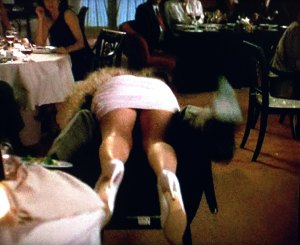
FASHION BLOG 2

This space is now a Whore fashion blog. This is the only athleisure look one should contemplate leaving the house in.

Whore, the 1991 spin-off made by director Ken Russell and actor Theresa Russell (they are not married, nor are they brother and sister,) is a film that has plenty of dark and powerful details to share. If Pretty Woman’s filmmakers wrung their hands over a perceived lack of uplift and redemption in the script’s early form, Whore’s filmmakers recoiled from the plush fairytale that eventually emerged and sought to temper it with an infusion of pain, violence and human suffering.

Liz, Whore’s protagonist played by Theresa, is a downtown colleague of Vivian (Julia Roberts), working isolated traffic tunnels and the peripheries of hotel promenades. She speaks directly to us about her work, the standards of quality within it, its hazards and how she got started. There are similarities between the two women: both were intrigued by the quick cash sex work offered; both are adamant about condom use; neither kisses on the mouth. Liz, however, is under the thumb of a domineering and dangerous pimp and has lost her young son to foster care. No one asks her for directions and expects to get just directions.

For all the haughty dismissal of Pretty Woman’s fantasy elements, there is frank talk about aspects of the profession: the upsides of working without a pimp (“We say who, we say when, we say how much”); Vivian and her friend’s safety mantra when receiving a client (“Call me when you’re through. Take care of you!”); the specter of AIDS (“I get checked out once a month at the free clinic!” claims Vivian.) Vivian and Edward (played by Richard Gere) finally kiss on the mouth two-thirds into the movie after having kissed each other’s genitals during previous encounters. Considering the major turning point romantic kisses represent in other movies, a romance that deepens with a prostitute tentatively kissing her trick and then proceeding to have vanilla, missionary, “romantic” sex with him (in a big bed of all places) is a sly subversion of romantic comedy tropes.

FASHION BLOG 3

In three years, all these pieces will be on the racks at Urban Outfitters.

Whore’s popular origin narrative is that it was made “in reaction” to Pretty Woman. Reaction to what exactly? Its popularity? Who likes it in particular? Its plot where a woman shamelessly enjoys herself in luxury? A narrative where a whore does not suffer too desperately? Whore’s marketing tut-tutted that “You’ve seen the fantasy…” implying that Whore is the “reality.” Oddly, while the distribution company makes this boast, the film itself is suffused with a heightened, stagey quality that one can read either as an unfortunate consequence of an obviously minuscule budget or as a kindness extended from filmmakers to audiences navigating this upsetting material.

The film portrays the gang-rape of Liz off-screen, and we hear her cries as the attack begins. They have a tone of indignant surprise—“haaaaaaaaaaaaaayyyyyyeeeeeeee”—as if Liz can barely believe her circumstances have changed so drastically. “They were like animals,” Liz narrates, “just grunting and laughing….”[Indelible in the hippocampus is the laughter.] Liz is dumped on the side of a road, beaten, her clothes in tatters. A passer-by kindly offers to drive her to a hospital, but Liz asks instead to go home and tend to herself privately. This person mentions that he is a school teacher and Liz tells us that she was weary of what perverted frustrations he may want to work out on her, but instead her offers her a handkerchief with which to clean herself as well as the $20 Liz asks for.

Back to Gaitskill. In her essay she states that Secretary’s filmmakers “made the Pretty Woman version of my story.” She is generous to admit that the internal drama and the coded language make it almost impossible to make a movie out of. She is also cognizant of what add-ons were needed in order for the film to be viable in the North American marketplace. “For it to be commercially successful, a relationship between boss and girl needed to occur, and so it does. To be successful, the relationship must end in marriage, and so it does.” If these things don’t happen in the original short story, what else does? Could it be that it is something like Whore, where a female protagonist takes stock of her existence at the fringes of erotic experience? And what she has to say has sharp edges and lurches toward unnerving conclusions?

Gaitskill writes “that Americans are in truth profoundly, neurotically terrified of being victims, ever, in any way…. Whatever the suffering is, it’s not to be endured, for God’s sake, not felt and never, ever accepted. It’s to be triumphed over. And because some things cannot be triumphed over at all, the “story” must be told again and again in endless pursuit of a happy ending.”

Sex workers and clients can find their relationship evolve beyond transactional. Sex workers can charge high fees and work in high-end settings. Sex workers can also work in the trade willingly and securely. However, sex workers, as Liz does in Whore, can also face circumstances they should not have to endure: police harassment; forcible confinement; exploitation; enablement of addiction; isolation from community; threats to their families and friends; violence; rape.

FASHION BLOG

Prom night look.

What is a happy ending anyway? Whore ends on a note of grace for Liz when her pimp, viciously beating her at the time, is killed by a street person acquaintance of Liz. The audience knows that Liz, because of her work, is known to the police. It doesn’t look good, but the concluding image of the film is Liz, after cleaning herself up, ascends the ramp of the parking garage/crime scene into the light of the morning. For filmmakers that are refuting purported fantasies, the right place/right time twist of the street person’s actions tips the film into the realm of the fantastic.

Pretty Woman ends with Edward sweeping Vivian off her feet to an undefined future after she has a bus ticket to San Francisco, vague plans to finish her high school education and $3000 in her pocket to get her started (not to mention a week’s worth of designer clothes.) The exchange between Edward and Vivian—“So what happens after he rescues her?/She rescues him right back!”—is a worryingly non-specific statement of expectation on which to base a future and still does not solidify the nebulous role in Edward’s life Vivian previously expressed apprehension over. While not conceived by Lars von Trier, the end of Pretty Woman is unsettling nonetheless. Vivian riding a coach trundling along the Pacific Coast Highway, a windfall in her pocket and her future as wide open for her as the ocean out her window is vast? Now that would be fantastic.

WORKS CITED

Gaitskill, Mary. “Victims and Losers: A Love Story–Thoughts on the movie Sectretary.” Somebody With A Little Hammer. New York: Pantheon Books, 2017

Pretty Woman. Dir. Garry Marshall. 1990

Final Analysis

Dr. Isaac Barr (Richard Gere), about a third of the way into Final Analysis (1992), tells us “A shoe salesman looks at people’s feet. I look at their thoughts.”  He’s a Freudian psychiatrist probing Diana’s (Uma Thurman) dreams of flower arranging and gun handling for subsumed sexual motivation while letting the trauma of a past sexual assault she hints at flop around the session like a trout suffocating on a dock. 

Directed with a De Palmaniac flair by Phil Joanou (and dodging a loan shark for debts owed to Vertigo), Final Analysis asks who gets the last word on wrongdoing: the perpetrator or the bystander. Kim Basinger enters the plot as Heather, Diana’s sister, ready to provide to Isaac the family backstory Diana is reluctant to reveal in her sessions. Heather and Isaac quickly become lovers, though Heather has not arranged a non-monogamous relationship with Jimmy Evans (Eric Roberts), her “Greek Orthodox gangster” husband. 

“Fucking his wife is like teasing King Kong,” a lawyer friend of Isaac’s says of Jimmy. We are told that Jimmy was born Dimitri Evangelou in Greece, emigrated from Athens at 18 “to avoid the draft,” and presently works in construction, pension fund scams, bid rigging, and money laundering.  Eric Roberts’ tanned, toned form is coiled tight, making him the ideal heartthrob for the folks who eroticise tangles of copper wire. His introductory scene in the film concludes with Heather fellating him under strongly implied physical threat.  

My kind of scrap metal yard

Coiled tight

The foundation of Final Analysis is a set of assumptions about the world it seeks to portray. One is that corruption and violence are not abhorrent enough in and of themselves. Another is that the phrase “Greek Orthodox” evokes otherness and that otherness naturally evokes danger. If one wishes to make a connection between these two assumptions, Final Analysis is not preventing one from doing so. However, it must be said that Eric Roberts is nowhere near as hairy nor tall as King Kong and that the comparison is an inappropriate one. 

Where Jimmy is a threat to Heather (and Isaac and Diana by their association with her), one can’t help feel that both Heather and Diana are not exactly safe with Isaac either. He boasts to a buddy of Diana, “I have an attractive-seductive young woman for a patient!” The same buddy–he is a psychological expert Heather will call on later–loudly declares “No woman is so beautiful your normal thought processes fly out of your head” just as Heather walks into the room and he subsequently loses his train of thought. Heather and Diana are portrayed as desired objects for the men around them and it is not a stretch that if they are able to escape the clutches of Jimmy, Isaac and his cronies are not going to be much help afterwards. 

My dinner with the Evans couple

Pathological intoxication

Heather kills Jimmy during a spell of pathological intoxication, a crime for which she is found not guilty by reason of temporary insanity thanks to the testimony of Isaac and the psychological expert buddy, as well as his lawyer friend’s defence. Isaac then learns that Heather is to receive a giant insurance pay-out and suspects she may have pre-meditated the murder of Jimmy all along. At this point, the questions of ‘do all murders need to be avenged?’ and ‘do I really want to watch the rest of this movie?’ fuel the engine of the second half of the film. Isaac elects to sort out Heather’s plot, less so out of an obligation to pursue justice for Jimmy than his need to avenge his humiliation at being so manipulated by a woman. Heather living out her days with a tidy insurance sum and free of a dangerous asshole is a happy ending for a film meant for children. Final Analysis’ gaze is directed toward sleek, grown-up problems, not fairy tales about financial security and freedom from violence. 

The film’s real-world point-of-view is that men are excused of a lack of control when it comes to beautiful women and said beautiful women are not equally excused taking advantage of that lack of control. And women deserve to be punished if they manipulate you into helping their perverse campaign for freedom. That the word ‘dumbbell’ – the object itself is a plot McGruffin – is used to excess in the dialogue underscores the stupefying wonder to behold in Isaac’s effort to reclaim his manhood. Final Analysis boasts a shattering thesis: it is easier to concoct a two-year plot to manipulate a dumbbell mental health professional to justify you killing your husband than it is to count on the economic, social and legal support needed to successfully leave an abusive relationship. 

Originally published on January 9, 2019.

Updated on January 22, 2019 to included new post category and tags.