PART 1: CRIMES AGAINST WOMANHOOD
“Vengeance is a lazy form of grief,” says Tara Brach, an American psychologist and mindfulness teacher. Peyton Flanders (Rebecca de Mornay) in The Hand That Rocks The Cradle has a lot to grieve when she moves into Claire Bartel’s (Annabella Sciorra) home with the intent to crush it to dust. Her husband (John de Lancie) has been indicted on charges of sexually assaulting his patients at his OB-GYN practice and he has committed suicide at the height of these criminal proceedings. As a result of a class action lawsuit brought against her husband’s estate by his victims, Peyton has lost her home, her money, and, finally, she has lost her pregnancy through miscarriage. Claire was assaulted by the doctor-husband and was the voice that finally brought attention and consequences to bear on the doctor. Peyton diverts her pain and grief into a plot to splinter Claire’s family and home, opting for murder and mayhem where therapy, journaling, community intervention, righteous feminist anger and a healing circle would help.
The quote above comes from an online lecture by Brach called Awakening Through Conflict and is the climactic statement in a tale about a family within an African tribe given the choice to swim out to the middle of a lake to save a drowning man who caused the death of a family member or to let the man drown while observing from the shore. Claire is targeted by Peyton after a news broadcast names her as the original complainant against Peyton’s husband, though the broadcast also notes that Claire has declined to participate in the lawsuit against the estate. (We are not told if Claire filed a standards and practices complaint with the FCC.)
We don’t know the details of Peyton’s marriage, aside from the observation that she was definitely left treading water in the middle of a lake by her husband. We are given no details about the individuals who pursue legal action against the doctor-husband. Claire, in being named as the “first” complainant and as not pursuing the lawsuit, is implicitly conveyed as a model of bravery, resilience, and grace. On her own to swim back to shore, Peyton, once she gets there, aims to pursue a conflict with the only name she has to go on.

Nice work of mise en scène here
Peyton poses as a prospective nanny eager to work for the overwhelmed Claire. Claire has a newborn son at home, a young daughter, a backyard greenhouse that needs construction and experiences debilitating, stress-induced asthma attacks. Yes, this is a lot to handle, but Claire owes it to herself to go through a more rigorous hiring process for Peyton rather than just serving her tea after a chance meeting on the street. Nevertheless, Peyton moves in and swiftly works to marginalize Claire from her own family. In doing so, Peyton fulfills the ‘lazy’ part of the “vengeance is a lazy form of grief” adage.
Peyton’s gambit is to frame Claire for various crimes against womanhood, a tactic that, unfortunately, finds a receptive audience. At the top of the second/bottom of the third act of the film, Claire’s husband (Matt McCoy) laments to a friend that Claire “is not herself lately.” For the husband, Claire is a static form that the hot glare of sexual assault, childbearing, parenting and chronic asthma could never reshape over time.
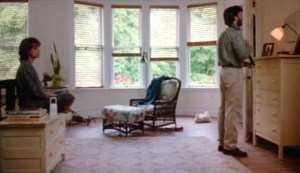
If the camera isn’t glaring at this man’s ass, then a character is helpfully drawing attention to it
Claire’s youngest child is around six months and still breastfeeding when Peyton takes up residence. As previously discussed, Peyton lost her child in miscarriage during the events of her husband’s downfall. Upon moving into Claire’s home, Peyton starts to surreptitiously breastfeed the baby, causing pain and confusion for Claire when the baby then resists her at his normal feeding time. Breastfeeding is a natural process that still takes care and patience and good circumstances to learn for both mothers and their infants. It is also a process under intense, external scrutiny: the patriarchal sexualization of the female breast; hostile conditions at work and in public spaces for feeding or pumping milk; an overall idealization of the breastfeeding process beyond the scientifically confirmed benefits and the turmoil mothers can feel when they are unable to produce milk or simply face normal challenges in feeding their babies from their breast. Though Claire is a fancy, suburban lady with live-in domestic assistance, she is still not immune to these atmospheric conditions. Peyton knows this and chooses to drive this wedge between a mother and her infant regardless.
Peyton also succeeds in undercutting Claire’s appreciation of her post-partum body by sabotaging Claire’s plan on wearing her favorite scorching red dress. Claire, despite being a fancy rich lady only owns one sexy dress. Option ‘B’ is a white linen sack, which can evoke the freewheeling eroticism of a farmers’ market shopper tripping on MDMA, but does Claire no good specifically when her friend (played by Julianne Moore, adding further insult to injury) shows up for the same night out in a neutron bomb of a little black dress. Peyton also broadcasts a signal specifically for the husband by rattling around the house in the middle of the night in a tiny night gown. Peyton’s body is also post-partum, but no one spilled perfume on her dress like Peyton did to Claire’s. It is unclear if the husband sees through Peyton’s ploy just like he can see right through Peyton’s white nightie.
The hijacking of Claire’s feeding schedule for her child and the unasked-for fashion intervention are part and parcel of Peyton’s overall campaign to split Claire from her feeling of security in herself and in her relationships. On top of all this, Peyton destroys a document Claire volunteered to mail for her husband, exchanges secrets with her eldest daughter and then plants Julianne Moore’s cigarette lighter on her husband’s jacket so as to create the waft of an affair. The insecurities that Peyton stokes in Claire get at larger anxieties around mothering, heterosexual womanhood and competitions between women for the attentions of a single man. Peyton has a keen eye towards conflicts that unfortunately are as shaped by external pressures as they are by interpersonal relationships.
PART 2: WHO SPEAKS OF… AND WHY?

This is the third time this has come up
In the documentary Horror Noire: A History of Black Horror, filmmakers Ernest R. Dickerson and Rusty Cundieff discuss the opening sequence of the 2017 horror film Get Out. “Lakieth [Stanfield, the film’s co-star], walking down the sidewalk at night in a suburban neighbourhood, on a cell phone, by himself—shit, I’ve been there. It was the perfect black horror story,” says Dickerson. Approximately two and a half decades prior, The Hand That Rocks The Cradle gave Get Out’s tensed shoulders a patronizing squeeze when introducing the Bartel family’s African-American, intellectually challenged handyman, Solomon (played by Ernie Hudson.)
Before they are introduced, Claire from the kitchen window of her grand Victorian-style home, is startled by Solomon walking the perimeter of her house, presumably looking for the correct door to knock on. Upon hearing her cries for help, Claire’s husband intervenes and discovers that Solomon is there from the Better Day Society, an organization that places intellectually challenged folks with employment opportunities. One wonders why this scene was there to begin with except to portray a white woman reacting with fear when surprised by a black man in her yard. The misunderstanding is never remarked upon again.
Solomon is adept at his job—fixing a fence, raising a birdhouse, painting the trim and hanging some wind chimes—and strikes up a nice rapport with the family, especially the young daughter Emma (played by Madeline Zima), who campaigns for him to be her nanny prior to Peyton being hired. He longs to hold the new baby, but Claire enforces a rule from the Better Day Society that says it’s best if Solomon does not handle the child.
In Horror Noire, Robin R. Means Coleman, whose book of the same name Horror Noire is based, begins a definition of the phenomenon of African-American incidental characters in horror films: “their roles are tokens and so they show up as sidekicks…” Tananarive Due, an author and educator also appearing in Horror Noire, picks up the thought: “…which would be fine except they don’t often exist for any other reason in the movie. They don’t have wants, needs of their own. Their only concern is the welfare of the white protagonist.”
This definition gives name to a recurring sour note in the films of Who Speaks Of…. Final Analysis and Sliver feature black police officers (played by Keith David and CCH Pounder respectively) with the sole responsibility of making sense of the sex-fueled shenanigans of the white characters. Whore’s protagonist Liz owes her life to the black street person she meets earlier in the film. It is worth noting also that when she shares her story of being ‘saved’ from a bad trick by her pimp upon their first meeting, it is the street person who says out loud that Liz was conned into the pimp’s control from the start. Bridget, in The Last Seduction, connects the dots between her coworker emphasizing that the P.I. who asked after her is a black man, her need to shake said P.I. off her tail and the utility of the racist idea of the licentious black male to do so. Now, in Cradle, Peyton sizes up the Bartel family and massages a power dynamic that disadvantages and eventually slanders Solomon.
Though she was not in the Bartel home yet when Solomon first arrived, Peyton unconsciously resurrected the cloud of suspicions he was introduced under when she plants a pair of Emma’s underwear in Solomon’s personal items for Claire to find. This is after he catches Peyton breastfeeding the baby and she threatens him saying, “Don’t fuck with me, retard. My version of the story will be better than yours.” Since we do not know the specifics of his intellectual abilities nor have insights into his temperament beyond his helpfulness in the Bartel home, we do not know if he is deliberate or not in his reticence to defend himself to Claire. Solomon is reduced to helpless victim while being villainized as a predatory black male.
Schlepping this baggage into the third act of the film, Solomon’s personal stake in the truth about Peyton is shaved down on behalf of the Bartel family’s wellbeing. After being falsely accused of preying upon their young daughter, we learn that Solomon has been keeping vigil over the family from afar, and leaps into action when Peyton becomes violent towards them. Claire and her family discard Solomon when they feel threatened by him. Solomon, facing an accusation with profound consequences, would be wise to discard their company as well, but instead remains in service to the family, even when they don’t know it and cannot compensate him fairly for it. For the Bartel’s, Solomon’s actions save them from their own bad decisions in the first place. Solomon’s reward? Finally being allowed to hold the new baby.
PART 3: A BRIDGE OVER A PUDDLE

The emotional climax of the film as far as I’m concerned
Brach, in her Awakening Through Conflict talk, posits that conflict arises when we have unhealed wounds from unmet fundamental needs. The tools that previously protected us from adverse emotional conditions where we were starving for safety, connection or understanding now distort opportunities to feel and address the emotions underpinning interpersonal conflicts. It is fair to label what Peyton is experiencing at the beginning of the film a crisis, and one can speculate on what the emotions storming through Peyton could be. One can also speculate on what unmet needs and poor emotional conditions Peyton survived so as to haphazardly assign blame and seek vengeance like she is the boss’ son-in-law whose car was keyed in the parking lot. It is also of note that aside from a brief scene with her lawyers and then with her doctors, there is no sense of community around Peyton. Was anyone, after her marriage and then her pregnancy ended, there to comfort Peyton and guide her toward an honest communion with her feelings?
The video box for Cradle coos that Claire has exactly what Peyton wants: “the perfect life and family.” True, there is a lot to envy, but it is hardly free from blemish or struggle. Some of Claire’s struggles—such as chronic asthma and the natural challenges of parenting two very young children—are buffered by her handsome, upper-middle-class life. Sometimes Claire inflicts the struggle, such as aspects of her relationship with Solomon. Sometimes her struggle is acutely relatable, such as the sexual assault and the ensuing aftermath, where her narrative is taken out of her hands for good (other women come forward and the doctor is stopped as a result) and for ill (Peyton.) Similar to its relationship with Get Out, Cradle reaches through time to sidle up with the present day and purr in its ear “Toots, I told you so.”
Why did Cradle go the route of Claire and Peyton being connected in this particular way as victim of and wife of a serial sexual abuser? Claire could have just as easily bought the house from the estate after Peyton’s husband’s suicide and Peyton could be wild with indignation that Claire and her family get to live it up where Peyton’s dreams for a family of her own were blown to bits. Instead, Cradle pursues a stomach-churning dramatic allegory of the collective super-ego (embodied by Peyton) twisting into a fury when voices (embodied by Claire) saying ‘I’m hurt,’ ‘You’re wrong’ or ‘This must stop’ gain traction.
In October 2017, Ronan Farrow published on newyorker.com Annabella Sciorra’s account of being raped by Harvey Weinstein, the repercussions of this assault on her personally and professionally and her reluctant decision to speak on the record as stories of other survivors of Weinstein’s violence and harassment were beginning to be shared in public. The piece states,
“Some of the obstacles that Sciorra and other woman believed they faced were related to Weinstein’s power in the film industry. Sciorra said that she felt the impact on her livelihood almost immediately. “From 1992, I didn’t work again until 1995,” she said. “I just kept getting this pushback of ‘We heard you were difficult; we heard this or that.’ I think that was the Harvey machine.”
Cradle was not produced by Weinstein nor his companies and Sciorra tells us in the piece that the attack happened after the film’s release. In the piece, Sciorra laments giving up her privacy to go on the record about her experience and wear publicly the label of survivor of sexual assault: “I’m an intensely private person, and this is the most unprivate thing you can do.” Why are we talking about it here? Because Sciorra herself endured the receiving end of misdirected conflict from a community refusing for decades to turn over a rock and take a hard look at the bugs and decay underneath. From being smeared as difficult in the immediate years after the attack to hearing from colleagues that silence was advisable when Farrow was reporting this story, Sciorra paid a price as an unwilling keeper or a community’s shameful secret.
Conflict is not Abuse, written by playwright, novelist and nonfiction writer Sarah Schulman, is a detailed exploration of the behavioral phenomenon of conflating interpersonal conflict (I.e. calls for accountability, misplaced fear, ignorance of the full context/motivation of remarks or actions) with abuse such as physical threat, emotional intimidation or willful withholding of resources or needed information. One sections outlines the specific experience of acting out past hurt and fear in the present tense toward an individual who turns a spotlight (knowingly or not) on that past pain. Peyton fixates on Claire as if Claire caused destructive harm, not Peyton’s husband. The audience is forced to guess if Peyton’s hurt goes back further than the end of her marriage and her pregnancy.
“Everyone needs to be parented,” writes Schulman. “By this I mean that every person needs to be helped, encourages, and supported in becoming accountable to themselves and others. To not be threatened by taking others into account. To not be frightened by difference.” The community around Peyton that could guide her towards these insights, ironically, is Claire, cultivating as they do a needed trust and intimacy if Peyton is able to do her child care job. Instead, Peyton superficially acts as a confidant to Claire, prodding her for details about herself and marriage that she can later twist to her benefit. Claire does not ask for reciprocal sharing and cannot therefore provide a sympathetic ear, insights and ideas for Peyton to move through what she is feeling.
Let’s contrast the faux intimacy of Claire and Peyton with the real-life friendship of industry colleagues Annabella Sciorra and Rosie Perez. Perez is reported in the newyorker.com piece as being one of the first individuals Sciorra discussed the alleged attack with. Perez witnessed Sciorra’s drift from a career that was “riding so high… It hurts me as a fellow-actress to see her career not flourish the way it should have.” Eventually, as Sciorra was seeking wisdom on whether or not to go public with her story, Perez shared her story of being herself a survivor of assault:
“I told her, ‘I used to tread water for years. It’s fucking exhausting, and maybe speaking out, that’s your lifeboat. Grab on and get out[.] I said, ‘Honey, the water never goes away. But, after I went public, it became a puddle and I built a bridge over it, and one day you’re gonna get there, too.”
Tread water. Lifeboat. Puddle. Bridge. Everybody needs to be parented back to shore.
WORKS CITED
Awakening Through Conflict – Tara Brach. YouTube Channel: Tara Brach. https://www.youtube.com/watch?v=50W4MSxQ79g. April 24, 2014
Farrow, Ronan. “Weighing The Costs of Speaking Out Against Harvey Weinstein.” newyorker.com. October 27, 2017. https://www.newyorker.com/news/news-desk/weighing-the-costs-of-speaking-out-about-harvey-weinstein
Horror Noire: A History of Black Horror. Dir. Xavier Burgin. 2019
Schulman, Sarah. Conflict Is Not Abuse: Overstating Harm, Community Responsibility, and the Duty of Repair. Vancouver: Arsenal Pulp Press, 2016


 Yes Really Titley