In a 2003 essay for Zoetrope: All-Story, Mary Gaitskill relates a discussion she had with Steven Shainberg, the filmmaker of Secretary, the 2002 film based on her short story of the same name, where he attempted to reassure her that her complex material was going to be respected because he knew specifically how Pretty Woman was ‘ruined’ by Hollywood:
“He expressed outrage at the light and charming spin the movie had put on the innately painful and degrading subject; his indignation was so excessive that I actually felt roused to defend a film I didn’t think much of. Yes, it was phony and insipid, but Hollywood is phony and insipid about housewives and mothers, and I wasn’t especially indignant regarding this treatment of prostitutes, whom I didn’t see as innately degraded.”
Just like Mary Gaitskill, one does not have to particularly like Pretty Woman to be subjected to unasked-for details about the “dark and powerful story” contained within the original script, later “ruined by philistines.” (Both quotes are from Gaitskill.) Anti-Woman crusaders are likely to tell you…
Vivian wasn’t flossing. She was using cocaine!
She doesn’t end up with Richard Gere either. She goes to Disneyworld…to blow Goofy!
Richard Gere was the Golden State Killer!
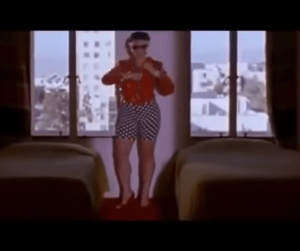
This space is now a Whore fashion blog. This is the only athleisure look one should contemplate leaving the house in.
Whore, the 1991 spin-off made by director Ken Russell and actor Theresa Russell (they are not married, nor are they brother and sister,) is a film that has plenty of dark and powerful details to share. If Pretty Woman’s filmmakers wrung their hands over a perceived lack of uplift and redemption in the script’s early form, Whore’s filmmakers recoiled from the plush fairytale that eventually emerged and sought to temper it with an infusion of pain, violence and human suffering.
Liz, Whore’s protagonist played by Theresa, is a downtown colleague of Vivian (Julia Roberts), working isolated traffic tunnels and the peripheries of hotel promenades. She speaks directly to us about her work, the standards of quality within it, its hazards and how she got started. There are similarities between the two women: both were intrigued by the quick cash sex work offered; both are adamant about condom use; neither kisses on the mouth. Liz, however, is under the thumb of a domineering and dangerous pimp and has lost her young son to foster care. No one asks her for directions and expects to get just directions.
For all the haughty dismissal of Pretty Woman’s fantasy elements, there is frank talk about aspects of the profession: the upsides of working without a pimp (“We say who, we say when, we say how much”); Vivian and her friend’s safety mantra when receiving a client (“Call me when you’re through. Take care of you!”); the specter of AIDS (“I get checked out once a month at the free clinic!” claims Vivian.) Vivian and Edward (played by Richard Gere) finally kiss on the mouth two-thirds into the movie after having kissed each other’s genitals during previous encounters. Considering the major turning point romantic kisses represent in other movies, a romance that deepens with a prostitute tentatively kissing her trick and then proceeding to have vanilla, missionary, “romantic” sex with him (in a big bed of all places) is a sly subversion of romantic comedy tropes.

In three years, all these pieces will be on the racks at Urban Outfitters.
Whore’s popular origin narrative is that it was made “in reaction” to Pretty Woman. Reaction to what exactly? Its popularity? Who likes it in particular? Its plot where a woman shamelessly enjoys herself in luxury? A narrative where a whore does not suffer too desperately? Whore’s marketing tut-tutted that “You’ve seen the fantasy…” implying that Whore is the “reality.” Oddly, while the distribution company makes this boast, the film itself is suffused with a heightened, stagey quality that one can read either as an unfortunate consequence of an obviously minuscule budget or as a kindness extended from filmmakers to audiences navigating this upsetting material.
The film portrays the gang-rape of Liz off-screen, and we hear her cries as the attack begins. They have a tone of indignant surprise—“haaaaaaaaaaaaaayyyyyyeeeeeeee”—as if Liz can barely believe her circumstances have changed so drastically. “They were like animals,” Liz narrates, “just grunting and laughing….”[Indelible in the hippocampus is the laughter.] Liz is dumped on the side of a road, beaten, her clothes in tatters. A passer-by kindly offers to drive her to a hospital, but Liz asks instead to go home and tend to herself privately. This person mentions that he is a school teacher and Liz tells us that she was weary of what perverted frustrations he may want to work out on her, but instead her offers her a handkerchief with which to clean herself as well as the $20 Liz asks for.
Back to Gaitskill. In her essay she states that Secretary’s filmmakers “made the Pretty Woman version of my story.” She is generous to admit that the internal drama and the coded language make it almost impossible to make a movie out of. She is also cognizant of what add-ons were needed in order for the film to be viable in the North American marketplace. “For it to be commercially successful, a relationship between boss and girl needed to occur, and so it does. To be successful, the relationship must end in marriage, and so it does.” If these things don’t happen in the original short story, what else does? Could it be that it is something like Whore, where a female protagonist takes stock of her existence at the fringes of erotic experience? And what she has to say has sharp edges and lurches toward unnerving conclusions?
Gaitskill writes “that Americans are in truth profoundly, neurotically terrified of being victims, ever, in any way…. Whatever the suffering is, it’s not to be endured, for God’s sake, not felt and never, ever accepted. It’s to be triumphed over. And because some things cannot be triumphed over at all, the “story” must be told again and again in endless pursuit of a happy ending.”
Sex workers and clients can find their relationship evolve beyond transactional. Sex workers can charge high fees and work in high-end settings. Sex workers can also work in the trade willingly and securely. However, sex workers, as Liz does in Whore, can also face circumstances they should not have to endure: police harassment; forcible confinement; exploitation; enablement of addiction; isolation from community; threats to their families and friends; violence; rape.
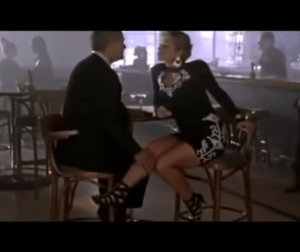
Prom night look.
What is a happy ending anyway? Whore ends on a note of grace for Liz when her pimp, viciously beating her at the time, is killed by a street person acquaintance of Liz. The audience knows that Liz, because of her work, is known to the police. It doesn’t look good, but the concluding image of the film is Liz, after cleaning herself up, ascends the ramp of the parking garage/crime scene into the light of the morning. For filmmakers that are refuting purported fantasies, the right place/right time twist of the street person’s actions tips the film into the realm of the fantastic.
Pretty Woman ends with Edward sweeping Vivian off her feet to an undefined future after she has a bus ticket to San Francisco, vague plans to finish her high school education and $3000 in her pocket to get her started (not to mention a week’s worth of designer clothes.) The exchange between Edward and Vivian—“So what happens after he rescues her?/She rescues him right back!”—is a worryingly non-specific statement of expectation on which to base a future and still does not solidify the nebulous role in Edward’s life Vivian previously expressed apprehension over. While not conceived by Lars von Trier, the end of Pretty Woman is unsettling nonetheless. Vivian riding a coach trundling along the Pacific Coast Highway, a windfall in her pocket and her future as wide open for her as the ocean out her window is vast? Now that would be fantastic.
WORKS CITED
Gaitskill, Mary. “Victims and Losers: A Love Story–Thoughts on the movie Sectretary.” Somebody With A Little Hammer. New York: Pantheon Books, 2017
Pretty Woman. Dir. Garry Marshall. 1990
 Yes Really Titley